
How Military Time is Measured
The fundamental means of measuring time is the rotation of the earth. The original standard by which all clocks are regulated is furnished from observation of the stars and their relationship to the earth.
The primary unit of time is the "mean solar day." A mean solar day is the average of the "true solar day," which varies slightly in length. There are four times a year the mean and true solar days are equal, by contrast there are also days which time could vary as much as 16 or more minutes. The difference between the mean solar time and true solar time is called the "equation of time."
Whether telling the time via the direct observation of the stars or some other means, precision is paramount to the military. For the precision required in navigation and the syncing of mission resources of today's armed forces, everyone must be on the same page.
The Master Clock
First thing to do is to make sure time is synchronized across the Department of Defense (DoD). United States Naval Observatory Precise Time Department (PTD) is responsible for maintaining a master clock which provides the DoD reference for Precise Time and Time Interval. The master clock, also known as the atomic clock, used for standardizing time across DoD is actually dozens of continuously scanned and averaged atomic frequency standards which provide a consistent result within a picosecond (one trillionth of a second)! Within one trillionth of a second -- you can't get much more accurate than that!
Nautical Time Zones
Every meridian has its own mean solar time. In order to avoid continual changing of time as one travels east or west standard time zones are introduced. Each time zone is 15 degrees of longitude in width. The difference between adjoining zones is one hour.
Nautical time zones are used by the military to ensure a standardization of time for the forces. Standard military orders would be delivered in Zulu time. Zulu time is the same as "Greenwich Mean Time" or GMT. Depending on the ship or units location on the planet, it will determine the amount of offset required. For example, if the orders were to launch a mission at 1000 Zulu, and your ship was located near Tokyo, Japan in the "India" time zone -- the India time zone is GMT plus nine hours, so you would add nine hours to 1000 Zulu, and know your time to launch would be 1900 local time (India).
Military Time Zone Chart
| Time Zone | Time Offset | Major City |
|---|---|---|
| A (Alpha) | GMT +1 | Paris, France |
| B (Bravo) | GMT +2 | Athens, Greece |
| C (Charlie) | GMT +3 | Moscow, Russia |
| D (Delta) | GMT +4 | Kabul, Afghanistan¹ |
| E (Echo) | GMT +5 | New Delhi, India |
| F (Foxtrot) | GMT +6 | Dhaka, Bangladesh |
| G (Golf) | GMT +7 | Bangkok, Thailand |
| H (Hotel) | GMT +8 | Beijing, China |
| I (India) | GMT +9 | Tokyo, Japan |
| K (Kilo) | GMT +10 | Sidney, Australia |
| L (Lima) | GMT +11 | Honiara, Solomon Islands |
| M (Mike) | GMT +12 | Wellington, New Zealand |
| N (November) | GMT -1 | Ponta Delgada, Azores |
| O (Oscar) | GMT -2 | Godthaab, Greenland |
| P (Papa) | GMT -3 | Buenos Aires, Argentina |
| Q (Quebec) | GMT -4 | Halifax, Nova Scotia |
| R (Romeo) | GMT -5 | New York, NY United States |
| S (Sierra) | GMT -6 | Dallas, TX United States |
| T (Tango) | GMT -7 | Denver, CO United States |
| U (Uniform) | GMT -8 | Los Angeles, CA United States |
| V (Victor) | GMT -9 | Juneau, AK United States |
| W (Whiskey) | GMT -10 | Honolulu, HI United States |
| X (X-Ray) | GMT -11 | Nome, AK United States |
| Y (Yankee) | GMT -12 | Suva, Fiji |
| Z (Zulu) | GMT | Greenwich, England |
Note 1: Although located in the Delta Time Zone, local time in Afghanistan is GMT +4 hours 30 minutes.
Note 2: Although not normally utilized in military communication due to the confusion it can cause, the time zone J (Juliet) has be used to indicate the observer's local time in other forums.
Military Time Conversion
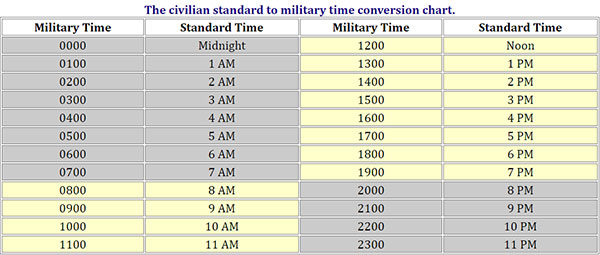
The United States military, including maritime, land, and air forces, use a 24 hour clock to save confusion. There are not two "seven o'clocks" in military time as there is with civilian standard time. The civilian 7:00AM is equal to 0700 (Zero seven hundred) and 7:00PM is equal to 1900 (Nineteen hundred) military time.
A couple more examples of local time conversion and how to speak it: if local time is 9:27 AM, the local military time would be 0927, and it would be spoken as "Zero nine twenty seven." If the local time was 7:36 PM, the local military time would be 1936, and it would be spoken as "Nineteen thirty six."
Standard Time to Military Time Converter
| Military Time | Standard Time | Military Time | Standard Time |
|---|---|---|---|
| 0000 | Midnight | 1200 | Noon |
| 0100 | 1 AM | 1300 | 1 PM |
| 0200 | 2 AM | 1400 | 2 PM |
| 0300 | 3 AM | 1500 | 3 PM |
| 0400 | 4 AM | 1600 | 4 PM |
| 0500 | 5 AM | 1700 | 5 PM |
| 0600 | 6 AM | 1800 | 6 PM |
| 0700 | 7 AM | 1900 | 7 PM |
| 0800 | 8 AM | 2000 | 8 PM |
| 0900 | 9 AM | 2100 | 9 PM |
| 1000 | 10 AM | 2200 | 10 PM |
| 1100 | 11 AM | 2300 | 11 PM |
Reading The Message Traffic "Day Time Group"
When message traffic is sent, each message receives a Day Time Group (DTG). The DTG has the day, month, year and time the message is logged. For example, a message's DTG may say, 212200Z May 2024. Broken down, you know the message was logged on May 21, 2024 at 2200 Zulu time.
Written by NCCM Thomas Goering, USN (Retired).
Article published on September 22, 2015.
Article modified on June 20, 2022.
